
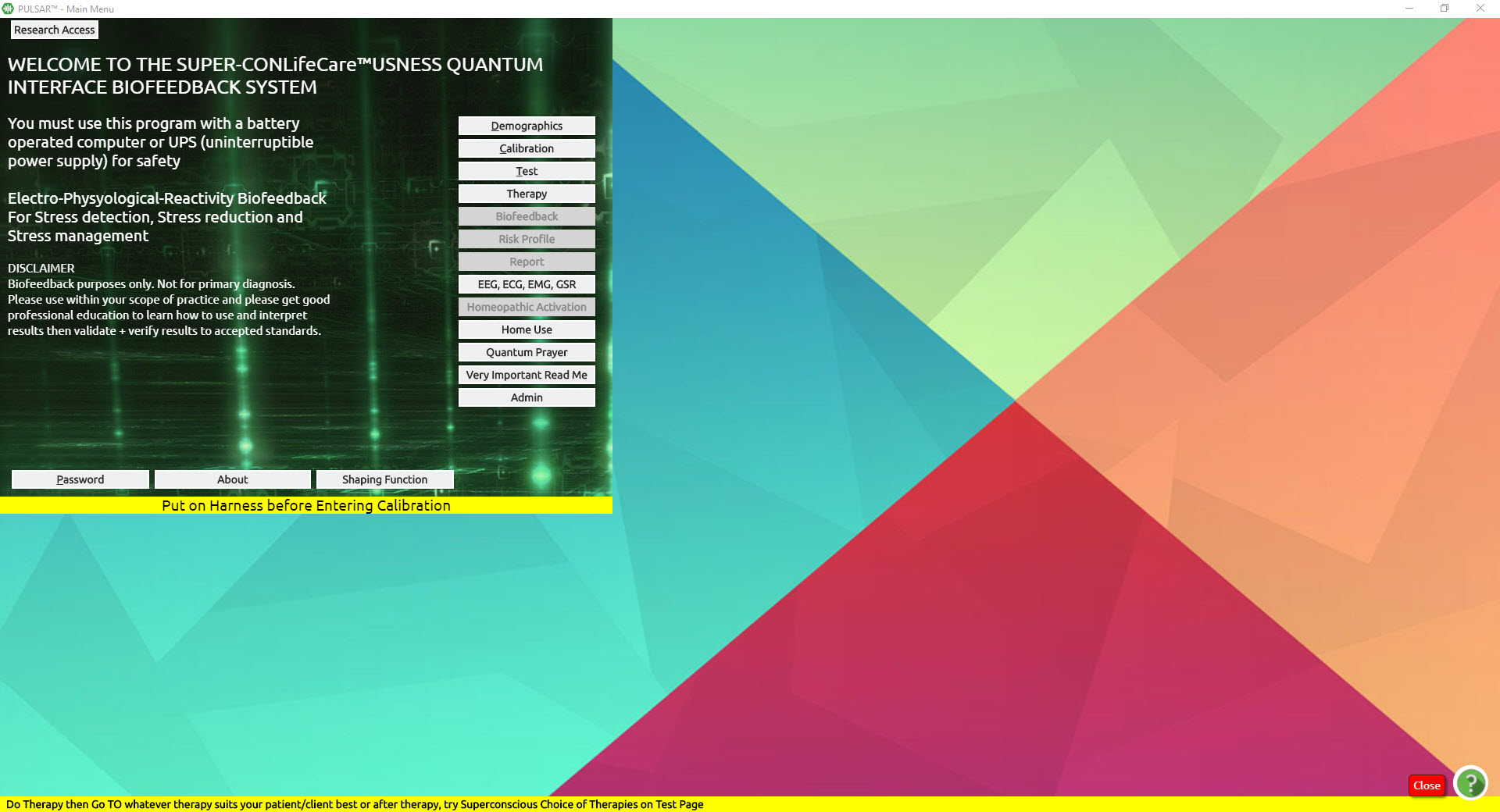
The VARHOPE panel first appears by clicking TEST in the main panel, after you have gone through the process of Calibration. They are the initial reactivity numbers after the first handshake of the Calibration.
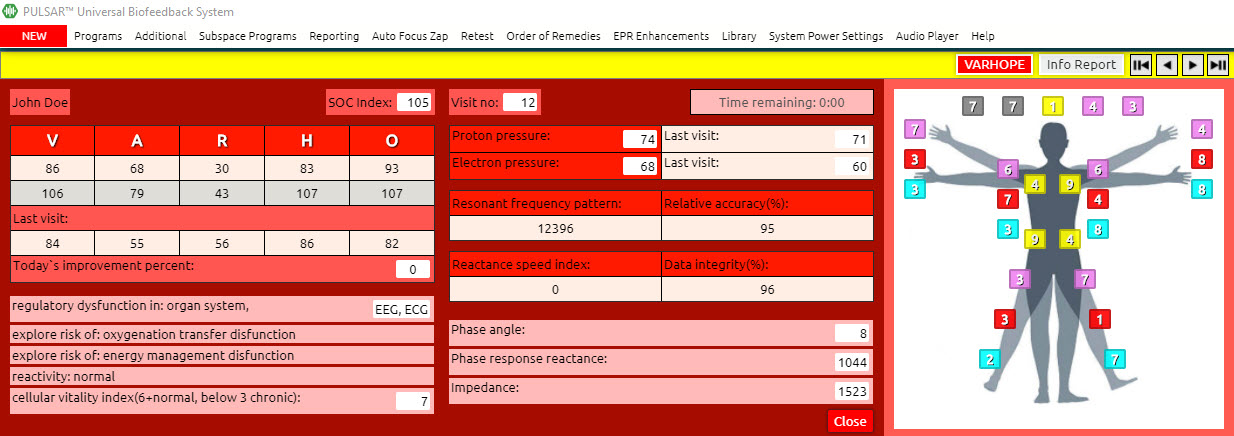
You can also access the VARHOPE screen, from the VARHOPE button:
The VARHOPE values (appearing in the red access panel) are for educational purposes. They are an indication of energetic parameters. Low VARHOPE values generally indicate an energetic weakness i.e. stress. These values may also give you information about the client’s lifestyle habits.
Information such as client name, number of visits, and last visits VARHOP values is also mentioned on this panel. There is also information on “regulatory dysfunction”, “explore the risk of” and “reactivity” fields that can give you hints and ideas on how you can plan your session.
Regulatory Dysfunction is a primary electrical concern that needs to be addressed that day. Common examples that may come up include spinal energy flow, EEG, ECG, and metabolic error dysfunction.
The Explore Risk items are secondary electrical concerns of that day that also need to be addressed.
Reactivity response ideally may be either normal, hyporeactive which is slow reactivity, under the normal, or hyper-reactivity indicating over the normal reactivity. Reactivity Dysfunction may indicate both hyper and hypo reactivity.
In order to have a good understanding of the readings, it takes experience and good knowledge of each parameter and combination to look for.
Let us see however the Interpretation of the VARHOPE values as follows:
V = Voltage:
- Energetically reflects stress related to adrenal function and willpower
- This shows us possible chronic fatigue or fatigue in general.
- The normal range is 80 – 100, Below 50 is chronic.
A = Amperage:
- Energetically reflects stress related to brain function, serotonin, life force
- The normal range is 80 – 100, Below 50 is chronic.
R = Resistance:
- Energetically reflects overall stress related to ease of energy flow in the meridians of the body.
- This may reflect toxicity causing resistance or emotional resistance
- The normal range is 80 – 100, Below 50 is chronic.
H = Hydration:
- Energetically reflects stress related to the body’s water absorption on a cellular level.
- Not necessarily how much water one may drink but actually what they absorb.
- The normal range is 80 – 100, Below 50 is chronic.
O = Oxygenation:
- Energetically reflects stress related to the ease of oxygen flow in the body; reflected at the cellular level.
- This can be interpreted into oxygen level, blood issues, hyperventilation, nutritional issues
- The normal range is 80 – 100, Below 50 is chronic.
P = Proton Pressure:
- Energetically reflects stress related to the body’s energetic pH.
- The normal range is 65 – 70.
- The overall energetic pH is considered to be the most balanced when the numbers between Proton Pressure and Electron Pressure are within 10 points or less of each other.
E = Electron Pressure:
- Energetically reflects stress related to the whole of the body’s electrical functioning. This may be an energetic indication of the number of available electrons.
- A good range is 70 – 75.
Cellular Vitality – associated with the electrical energy present in the cell, components of cell vitality are linked to oxygenation, protein digestion or blood issues/anemia, and essential fatty acid intake. 6 and above is normal whereas below 3 is chronic.
Resonant Frequency Pattern – represents the reactivity of the nervous system, tri vector signatures, and stored stress such as from unprocessed emotions, aging, sugar intake, or a spiritual issue. Below 1000 is associated with a risk of degeneration, and above 15.000 is possible nervous energy or psychic pain. When the Resonant Frequency Pattern is out of the normal range, it is recommended to train via the ECG and the ANS (Automatic Nervous System training programs.
Reactant Speed – represents the speed at which the body responds, such as to pathogenic tri vector signatures. Below 15 is ideal, below 40 is normal, and above 100 is stressed.
Phase Angle – represents the ability of the body to regenerate cells. This value represents a cellular aging index. 8 plus is ideal, 6 is normal and below 3 is chronic.
Phase Response – represents the ability of all the systems of the body to work together as an orchestra. 900 plus is ideal, 700 is normal and below 300 is of concern.
Impedance – represents the ability of energy to flow around and through the body. 1600 is ideal, below 1200 is weak and below 800 is of concern.
At the end of each session, you can go to
Retest
From the main matrix panel
Click on Test Varhope improvement
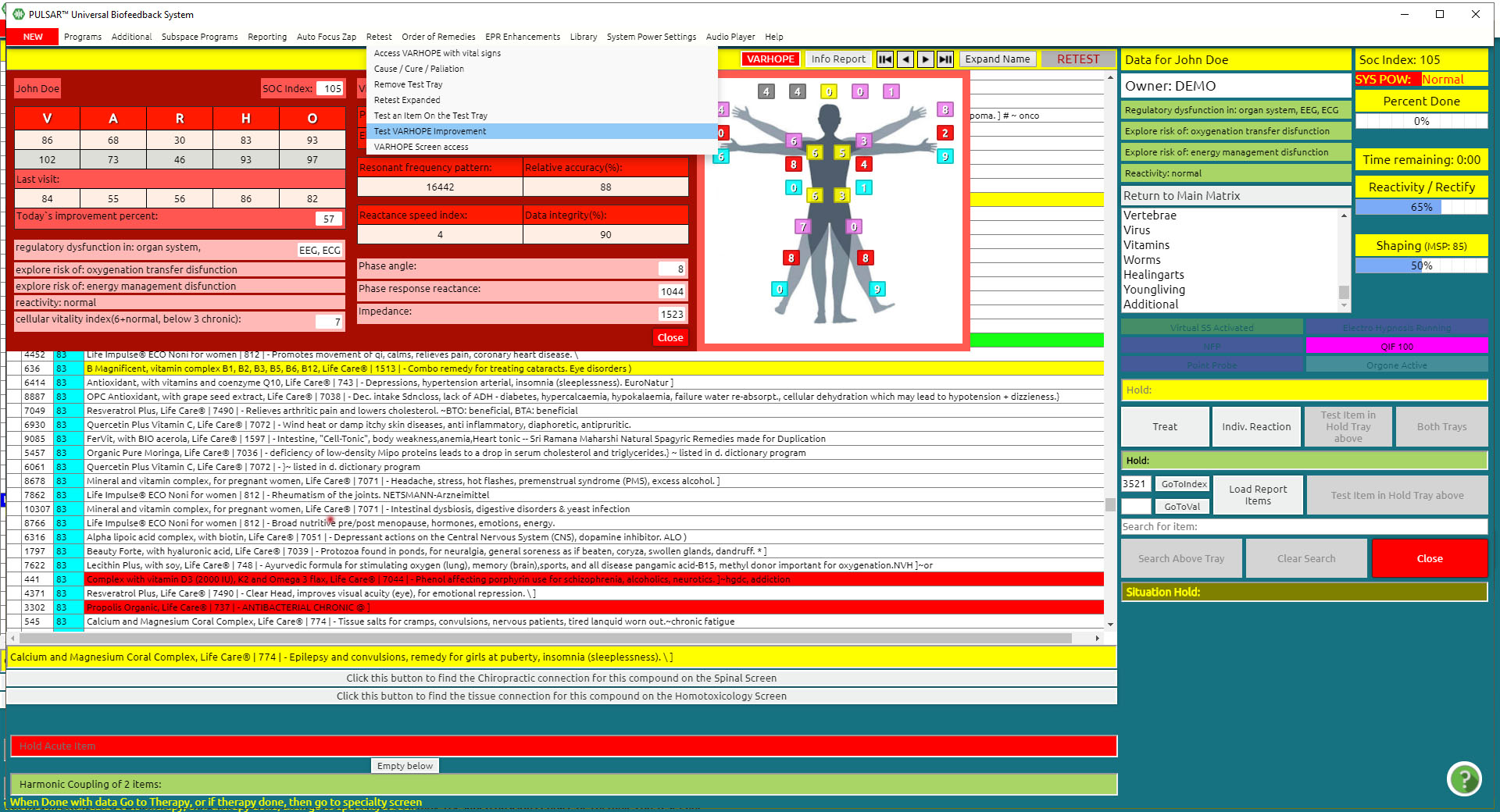
This will do a retest of 1.5 min giving you new values on your VARHOPE along with a percentage of improvement.
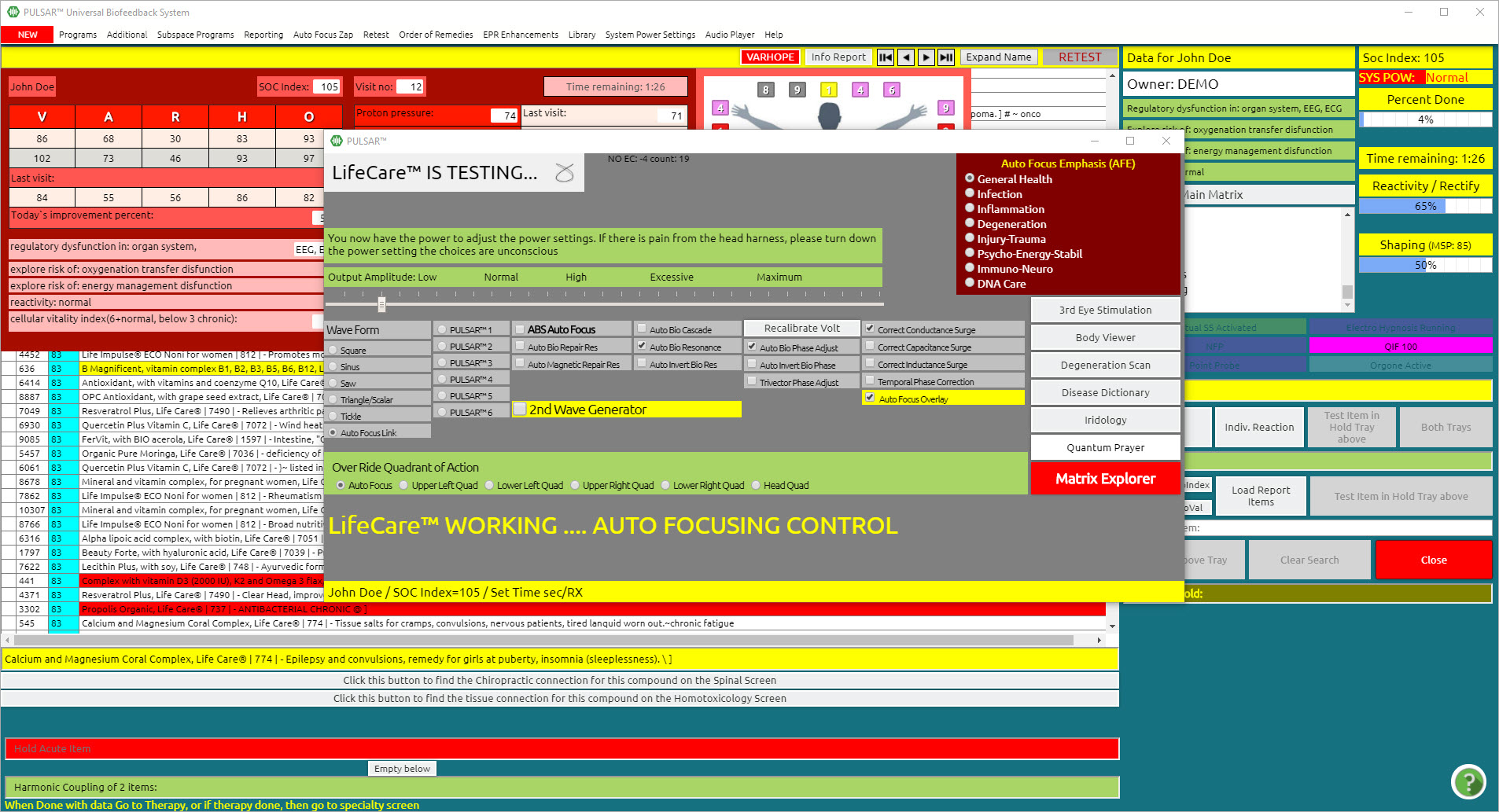
This percentage represents how much the person has reacted and improved electrically from their session.
Please keep in mind that even low or even negative percentage values of improvements do not mean that the session was not a good one, however, it just may mean that they may need some time, a day or two for the body to self-adjust electrically and absorb the therapy that was done on them.